
Democracy under attack?
-
In the last few days, Patreyk Narjid’s candidacy in the Prime Ministerial election was briefly called into question following a court filing by Willow Dziedzic MP. Though the Court ultimately ruled in his favour, allowing him to remain in the race, the situation has raised a broader concern:
Is Curnon’s democracy at risk?
How we got here
Curnon has long struggled with constitutional stability. Multiple attempts to draft a governing document were started and abandoned in the nation’s early development.
A breakthrough came in December 2024, when then Prime Minister Andrew Perdomo worked alongside Grand Premier Asa Ward to draft and ratify a Constitution. That document was intended to bring structure and clarity to governance after months of uncertainty.
However, following Perdomo’s later exile from Curnon, the decision was made to replace the Constitution entirely. A new document with no association to his leadership was introduced.
A flawed foundation
Despite its intentions, the current Constitution has been widely criticised for unclear wording, contradictions and loopholes.
The recent court case surrounding Narjid’s candidacy has brought these issues into focus. The dispute centred on the definition of a “Member of Parliament”, a term used throughout the Constitution without a clear, consistent definition.
This lack of clarity created a situation where a leading candidate’s eligibility could be questioned mid-election because of ambiguity in the law.
While the Court was able to resolve the issue in this instance, the fact that such uncertainty arose at all has led some to question the strength of the system underpinning Curnon’s democracy.
A system in need of reform
The issue of constitutional reform was already a central topic in the Prime Ministerial debate, even before the court case unfolded.
Both Rowan Mintz and Patreyk Narjid expressed support for introducing proportional representation, arguing that the current fixed parliamentary system is not suited to a growing population.
Mintz warned that a limited number of seats could restrict participation as Curnon expands. Narjid went further, suggesting that proportional representation, alongside local subdivisions, could “unlock” the nation’s democratic potential.
Narjid also called for broader structural reform, including a clearer balance of power between Parliament and the executive, and a system capable of adapting without requiring constant amendments.
Democracy at risk?
The events of the past few days do not necessarily indicate a collapse of democracy in Curnon. The Court functioned, a ruling was issued and the electoral process has continued.
However, they do highlight the fact that a democratic system is only as strong as the rules that govern it. When those rules are unclear or contradictory, even routine processes such as an election can become uncertain.
As Curnon approaches its upcoming vote, the question is no longer just who should lead the nation, but whether the system they inherit is fit for purpose.
Why the ‘boykisser state’ needs to appeal to the right wing
-
Appealing to the different groups was an issue that both Prime Ministerial candidates, Mintz and Narjid identified in the Prime Ministerial debate, with both candidates committing to making Curnon more tolerant and accepting of ‘right wing’ views.
Curnon, the ‘boykisser state’
Curnon has always been a progressive nation and has been associated with LGBTQ+ and furry symbols for as long as it has existed.
This, as well as promotion of Curnon towards these communities, has created attracted a mostly leftist and progressive citizenry.
For some time, Curnon was dubbed by some as a ‘furry’ or ‘gay’ nation- or even the ‘boykisser state’, though in recent months there has been a move by officials to distance it from these labels.
Image: “Join us you twink” poster by Kaunon, from the official Curnon Discord server.
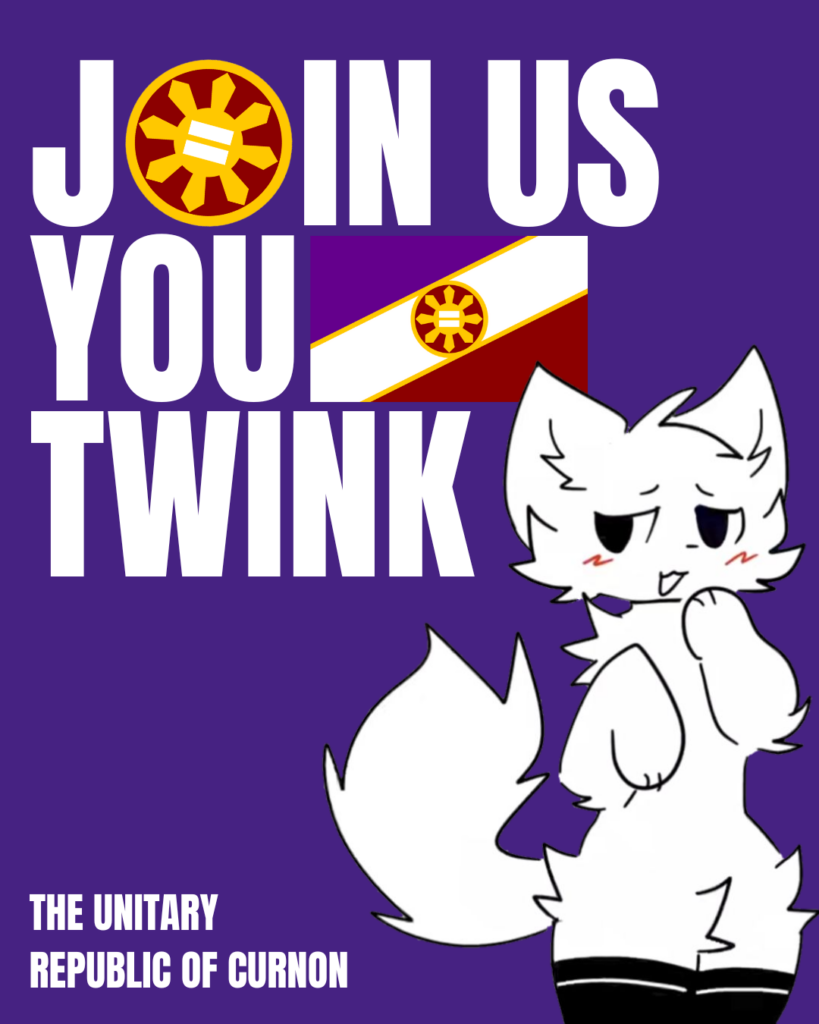
“Join us you twink” poster Curnon, the ‘untolerant’ state
Despite Curnon’s reputation as an inclusive and progressive space, both candidates suggested that its tolerance may not extend as far politically.
The Progress and Socialism Party’s Rowan Mintz, who identifies as left leaning, said that LGBTQ+ people are “well heard and represented” in Curnon, but argued that the nation lacks ideological diversity. They described right-wing voices, particularly on the social right, as “very few and far between”.
Mintz argued that while Curnon is tolerant in the sense that it is not discriminatory, it can also act as an “echo chamber” with limited dissent from dominant left-wing views. To address this, they proposed promoting Curnon on more neutral platforms and presenting it as “intellectual and accepting to more points of view”, rather than what they described as an “immature presentation”.
The People’s Civic Movement’s Patreyk Narjid, who identifies as right leaning, made a similar argument from a different perspective. He said that groups such as “social progressives” and “economic leftists” are most represented, while others, including “social conservatives” and “economic rightists”, are less heard.
Narjid also criticised what he described as a “Tumblr-adjacent safe space”, arguing that Curnon can be “very sensitive” and overly focused on emotion. In his view, true tolerance comes from “welcoming even those who you may not like personally” and engaging with different opinions through reason.
Both candidates also linked this issue to how Curnon is perceived. Mintz pointed to government inaction and controversial imagery as reasons why the nation may appear unserious, while Narjid said many view Curnon as “frivolous” or lacking credibility, partly due to its origins and reliance on Discord.
Their responses suggest that while Curnon is widely seen as socially inclusive, both candidates believe it struggles to accommodate a wider range of political views.
Grand Premier, Asa Ward has told the Times of Curnon that “a tolerant society can’t tolerate the intolerant”. He added that “our entire purpose is equality and treating people like people, which means the only Republicans Curnon can have are South Park Republicans”, raising questions about whether we will see any significant change in this term or at any point in the future.
Opinion article by Max Flanders
We have made the difficult decision to cancel the opinion column by Max Flanders.
-
Times of Curnon launches ‘MicroNews’
The Times of Curnon has launched ‘MicroNews‘, an intermicronational organisation which aims to connect news services from across the micronational world to make it easier to discover what is happening in the micronational space.
It now consists of eight member organisations since its launch on March 31st.
Future of Quackers Kingdom remains uncertain
The future of the Quackers Kingdom remains uncertain after Kaiser, Wyatt Herb, announced that he would be either abdicating or dissolving the nation.
The Kingdom had faced scrutiny over the last few weeks as a result of allegations of internal abuse, tolerance of extremist ideologies, and controversial leadership practices outlined in San Donia’s publication “The Herb Files”, which Herb denies.
Curnon celebrates Transgender Day of Visibility
On March 31st, Curnon celebrated Transgender Day of Visibility, a day dedicated to recognising and celebrating transgender people, raising awareness of their experiences, and advocating for equality and acceptance.
Bureau of Foreign Affairs urges nations to renew diplomatic relations
The Bureau of Foreign Affairs has announced that a two-week long renewal period for all diplomatic treaties will begin from April 8th.
Any nations seeking to continue diplomatic relations are required to reach out to BFA Secretary Kaunon, or face relations being severed. Allies and nations who signed treaties with Curnon at MicroCon are exempt from the requirement.